Security & Threat Model
Secure-by-Design Architecture & Multi-Cloud Protection
At Aetherial, security is not an afterthought—it is a core architectural pillar. We employ a Secure-by-Design philosophy to protect our multi-cloud identity management platform and the sensitive data of our customers.
1. Our Attack Surface
To maintain a proactive defense, we constantly monitor and harden the primary vectors through which an adversary might attempt to compromise the system:
Identity & Access
Integration Service Accounts and the Web Application.
Infrastructure
Data in transit, storage, and the transformation layers.
Development Lifecycle
Source code repositories, CI/CD pipelines, and the third-party supply chain.
2. Threat Landscape & Strategic Mitigations
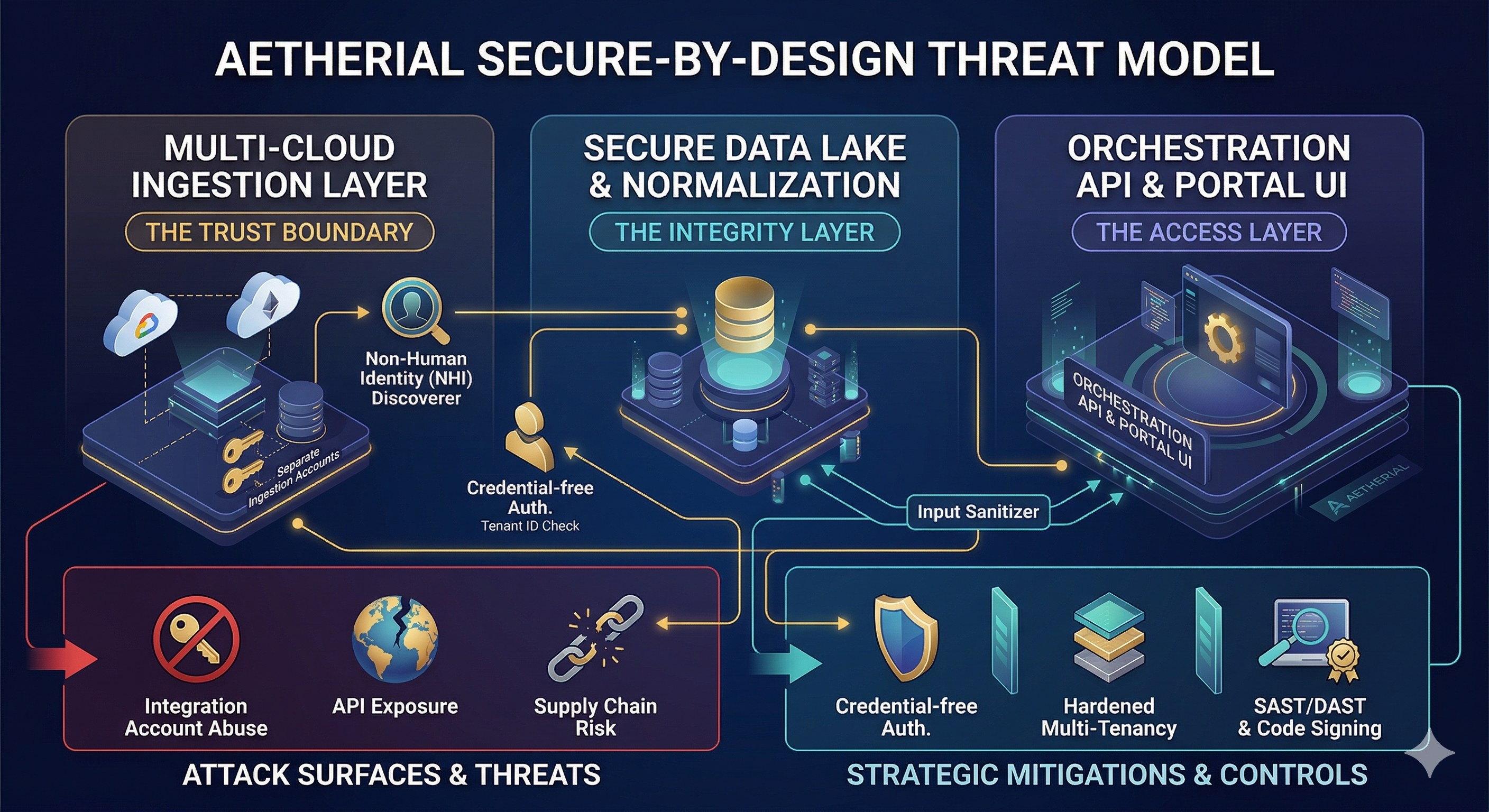
We utilize the STRIDE methodology to categorize threats and implement defense-in-depth controls.
| Threat Category | Potential Risk | Our Mitigation Strategy |
|---|---|---|
| Identity Spoofing | Compromised integration accounts leading to multi-tenant access. | Credential-free Authentication: We use federated, managed identities to eliminate static keys. Includes an "Integration Kill-Switch" for immediate containment. |
| Tampering & API Exposure | Unauthorized access to backend data or Command Injection. | Hardened Multi-Tenancy: We require a Tenant ID in every request and utilize API Gateways with strict input sanitization. |
| Supply Chain Disclosure | Vulnerabilities introduced via third-party libraries or CI/CD poisoning. | Integrity & Provenance: We use hardened CI/CD runners, code-signed build artifacts, and continuous SAST/DAST scanning. |
3. Architecture-Level Security
Our architecture is divided into three distinct layers, each with specific security functions:
The Trust Boundary (Ingestion Layer)
Mechanism: Uses AWS/Azure/GCP Ingestion Lambdas.
The Integrity Layer (Data Lake)
Mechanism: S3 + Neptune/OpenSearch.
The Access Layer (Orchestration API)
Mechanism: AppSync/API.
4. Core Security Principles
Minimize Blast Radius
We enforce strict separation of duties between data ingestion and remedial actions.
Defense in Depth
Multiple layers of scanning and signing ensure software integrity from the first line of code to the production environment.
Automated Governance
Our engine programmatically prunes excessive permissions and executes secret rotation without human intervention.